To Dither or Not to Dither that is the Question
Posted: Thu Sep 25, 2025 10:12 pm
Sorry for the play on Shakespear Title 
I was wondering / pondering dithering as the two images I posted recently to the gallery of Heart Nebula, and the Soul Nebula are not dithered.
They are calibrated with Darks, Bias, Dark flats, Flats and a Bad pixel map for integration.
My camera is the ASI2600MC Pro so I have no amp glow and modern CMOS camera's tend to have very little to no fixed pattern noise and also with the best will in the world polar alignment always tends to lead to a very slight amount of rotation during the course of long imaging sessions. So, for the two images I took recently this was over 4.5 hrs of acquisition and a subsequent 4hr integration for each so even without dithering there will be a degree of target/signal movement across the subs sequence on the sensor due to this rotation.
The other thing with dithering is that it is moving the pixels on the guide camera to achieve this and these are at a lower scale than the imaging scope so over the course of a long session this can lead to significant changes in the framing of the target in the imaging scope especially if the targets are close to multiple edges of the imaging sensor.
Any thoughts on this.
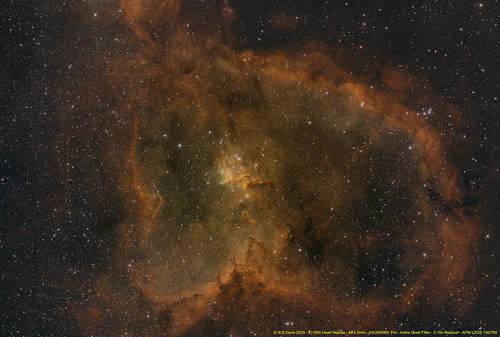
For reference these are the two images I am referring too.

Cheers
Nick
I was wondering / pondering dithering as the two images I posted recently to the gallery of Heart Nebula, and the Soul Nebula are not dithered.
They are calibrated with Darks, Bias, Dark flats, Flats and a Bad pixel map for integration.
My camera is the ASI2600MC Pro so I have no amp glow and modern CMOS camera's tend to have very little to no fixed pattern noise and also with the best will in the world polar alignment always tends to lead to a very slight amount of rotation during the course of long imaging sessions. So, for the two images I took recently this was over 4.5 hrs of acquisition and a subsequent 4hr integration for each so even without dithering there will be a degree of target/signal movement across the subs sequence on the sensor due to this rotation.
The other thing with dithering is that it is moving the pixels on the guide camera to achieve this and these are at a lower scale than the imaging scope so over the course of a long session this can lead to significant changes in the framing of the target in the imaging scope especially if the targets are close to multiple edges of the imaging sensor.
Any thoughts on this.
For reference these are the two images I am referring too.
Cheers
Nick
