Page 1 of 1
Occultation of Betelgeuse by Leona
Posted: Tue Dec 12, 2023 8:17 pm
by Jean-Francois
Hello Robin,
OK, thank. I will try it as soon as I can.
I'm in the south of Italy for the observation of the occultation of Betelgeuse.
It was this morning at 2 o'clock a success.
2 mounts, 4 telescopes with 5 cameras. 3 SharpCap instances on one computer for 3 different cameras and another SharpCap on a second computer.
The 4 SharpCap instances started automatically the 4 films with one of my Python script.
So I was very busy for setting all these equipment and the software and resolving the polar alignment and SynScan problems.
My intension was to use the QHY715C with a filter IR Planet 807, but I was very surprised of the low sensitivity (fast 10x) relative to a QHY178.
Is that coming from a problem in the SDK for the 715 camera ?
Regards,
Jean-Francois
Re: RGB balance with QHY715C camera
Posted: Wed Dec 13, 2023 7:54 pm
by Jean-Francois
Hello Robin,
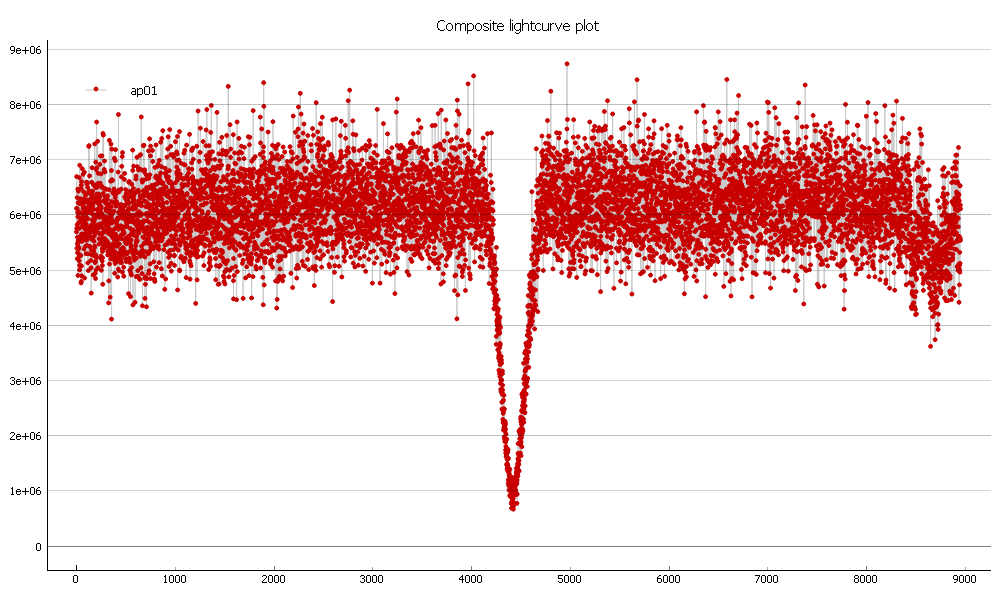
here the light curve done with the QHY-178 and the IR Planet 807 filter.
- Betelgeuse_Newton_QHY178_IR807.png (210.53 KiB) Viewed 14151 times
I have no image. It was no time for installing my Canon camera for the full Orion constellation view.
I'm surprised that the noise seems to disappear when the star starts to be occulted.
It is a little be the effect of the angle (projection) ... but who knows if one other effect is not present.
On the right side, we can see the variation coming from some clouds.
15 minutes before the event, a long cloud band was in the middle of Orion, also on the central 3 stars.
It was the big question to see the direction of the band ... perpendicular or parallel ? ... it was sufficient slow to not cover Betelgeuse at the moment of the occultation.
Regards,
Jean-Francois
Re: RGB balance with QHY715C camera
Posted: Thu Dec 14, 2023 1:45 pm
by admin
Hi Jean-Francois,
that's a very clear graph, and as you say it's weird that the dip introduces stability into the measurements - it seems such a clear difference from the noise in the reading before and after!
What was the timescale of the dip? Is there anything interesting scientifically that can be determined from the measurements?
cheers,
Robin
Re: RGB balance with QHY715C camera
Posted: Thu Dec 14, 2023 6:44 pm
by Jean-Francois
Hello Robin,
It was 20 ms single exposure and the dip is around 12 seconds.
Yes, the professional astronomers will try to scan the surface of Betelgeuse.
If the curve is very symmetric and homogenous, then it is an indication that the surface is homogenous.
I did the measurement in 5 different wavelength bands.
The professional astronomers will analyse the difference between the wavelength.
Regards,
Jean-Francois
Re: RGB balance with QHY715C camera
Posted: Thu Dec 14, 2023 8:07 pm
by oopfan
If my math is correct, that's a 2 magnitude drop.
There is noise in the dip. Please plot again for the range of 4000 to 5000 on the time scale.
Brian
Re: RGB balance with QHY715C camera
Posted: Fri Dec 15, 2023 1:48 pm
by admin
Also interesting that it didn't hit zero. Is that the light from the asteroid providing a floor of the measurement, light pollution or an indication that the whole disc wasn't occulted (the disc being very small obviously, but not quite strictly speaking a point source)?
cheers,
Robin
PS. Does anyone mind if I split the Betelgeuse related posts off to a separate thread?
Re: RGB balance with QHY715C camera
Posted: Fri Dec 15, 2023 3:50 pm
by oopfan
(Robin, please move this to its own topic.)
There is a site called Space Weather that I read daily. Several days before the event they had predictions. There was agreement to expect a 3 magnitude dip, but as the data rolled in from amateurs everyone reported 2 magnitudes. One respondent mentioned that Leona has an irregular shape.
Here is the "day after" reporting:
https://spaceweather.com/archive.php?vi ... &year=2023
Brian