
Last week there were suddenly some real clear nights and decided to give it a go. In the past I'd tried M81 and M82 but the IFN there is too wide for my f/10 (2032mm). But I did found another candidate: NGC 2633. The IFN there is in a smaller area.
And it did work
 But it's hardly visible in my capture, click it for the bigger version. Also, as reference, see https://www.astrobin.com/ygl0lr/D/ where it's visible way better so you know where to look in my capture
One of the reasons it's hard to capture, is the faintness. Nebulae in the plane of the Milky Way are "lit up" by one star of a group of stars. The IFN is outside the plane of the Milky Way though, so it's "lit up" by all the stars, a very diffuse light source.
So, the huge disadvantage was my Bortle 6/7 sky here. It prevented me to do 600sec captures with the IR/UV cut filter but 300sec with Gain 90 worked.
But I had to stretch a lot during processing and the vignetting did show up a little bit despite perfect flats. A price I happily pay.
For those wondering: the IFN are the very faint bands around (from left to right) NGC 2633, NGC 2634 and UGC 4585.
For more info on IFN, see https://en.wikipedia.org/wiki/Integrated_Flux_Nebula. It says there that it's a recent identified something. I looked it up and it has been identified in 2005. So yes, that's recent

Bortle 6/7
Meade LX200 8" f/10 ACF OTA
Ioptron CEM25EC mount (no guiding)
Baader IR/UV Cut filter
Baader Skyglow Neodymium filter
Zwo ASI071MC Pro camera
Captured with SharpCap Pro / White balance R50 B50
Baader IR/UV Cut: 44 x 300 sec / Gain 90 / Offset 10
Baader Skyglow: 52 x 300 sec / Gain 90 / Offset 10
20 x darks. And 50x flats + 50x darkflats per filter
Stacked with DeepSkyStacker
Stacked each filter set separate.
Photoshop: blended the 2 sets 50/50. And then 2 days of "playing" to get the right processing steps and results.
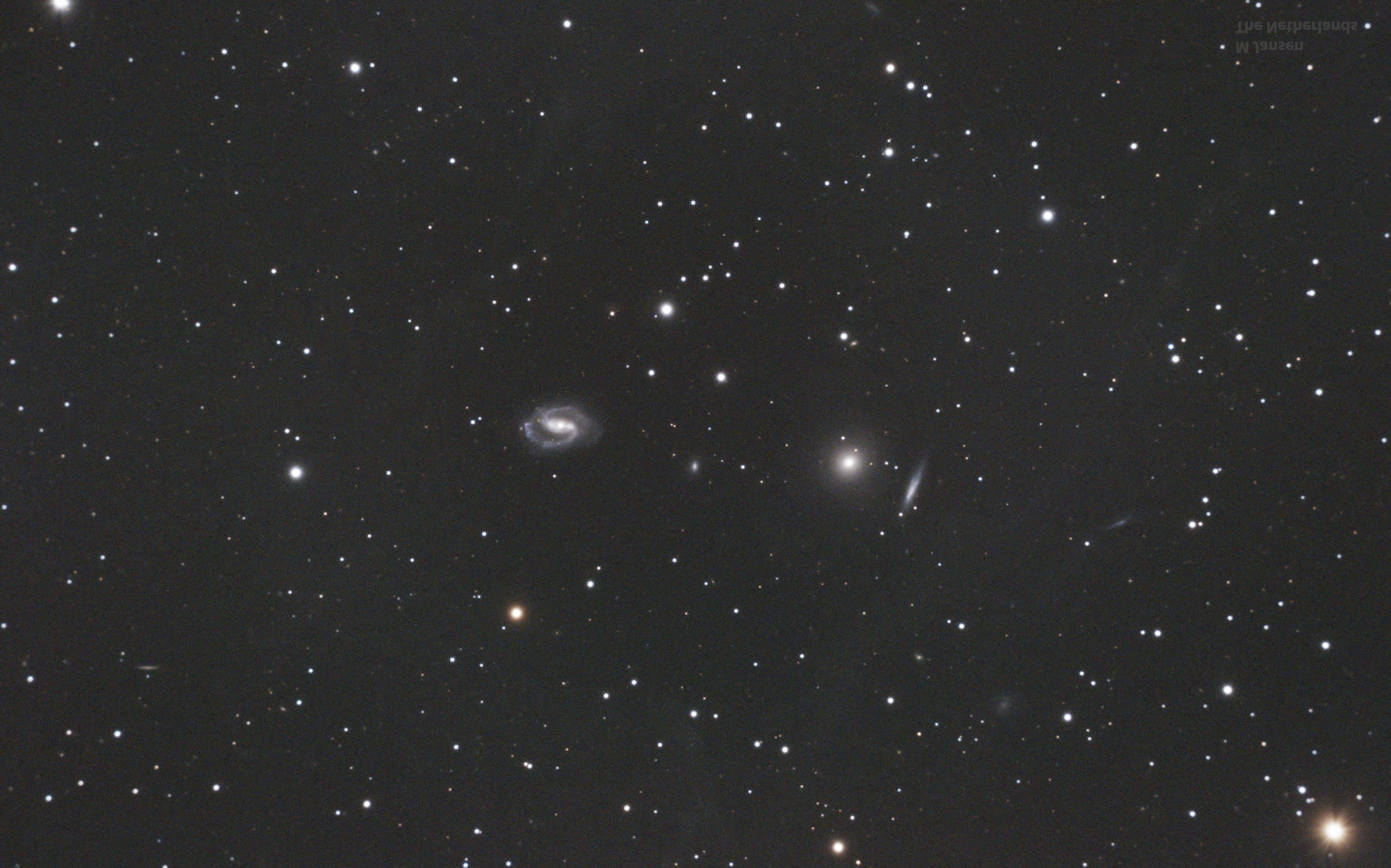

 ) I got the orientation wrong.