
Like usual
 I did set myself an almost impossible task (again) because it's very faint, it's small and only really visible in narrowband.
Combine this with my Bortle 6/7 sky and you get the picture

I did a test session of 2 hours and during that time, I did read about the fact that DQ Her is a variable star.
Not only is it variable by itself, it also variable because it's eclipsed by its companion star.
DQ Her is a white dwarf and its companion star is a red dwarf. They orbit each other tightly with a very short period of 4.65 hours and sits at around 1600 light years.
The 4.56 hours orbit time is of course insane: the speeds of those stars must be mind boggling

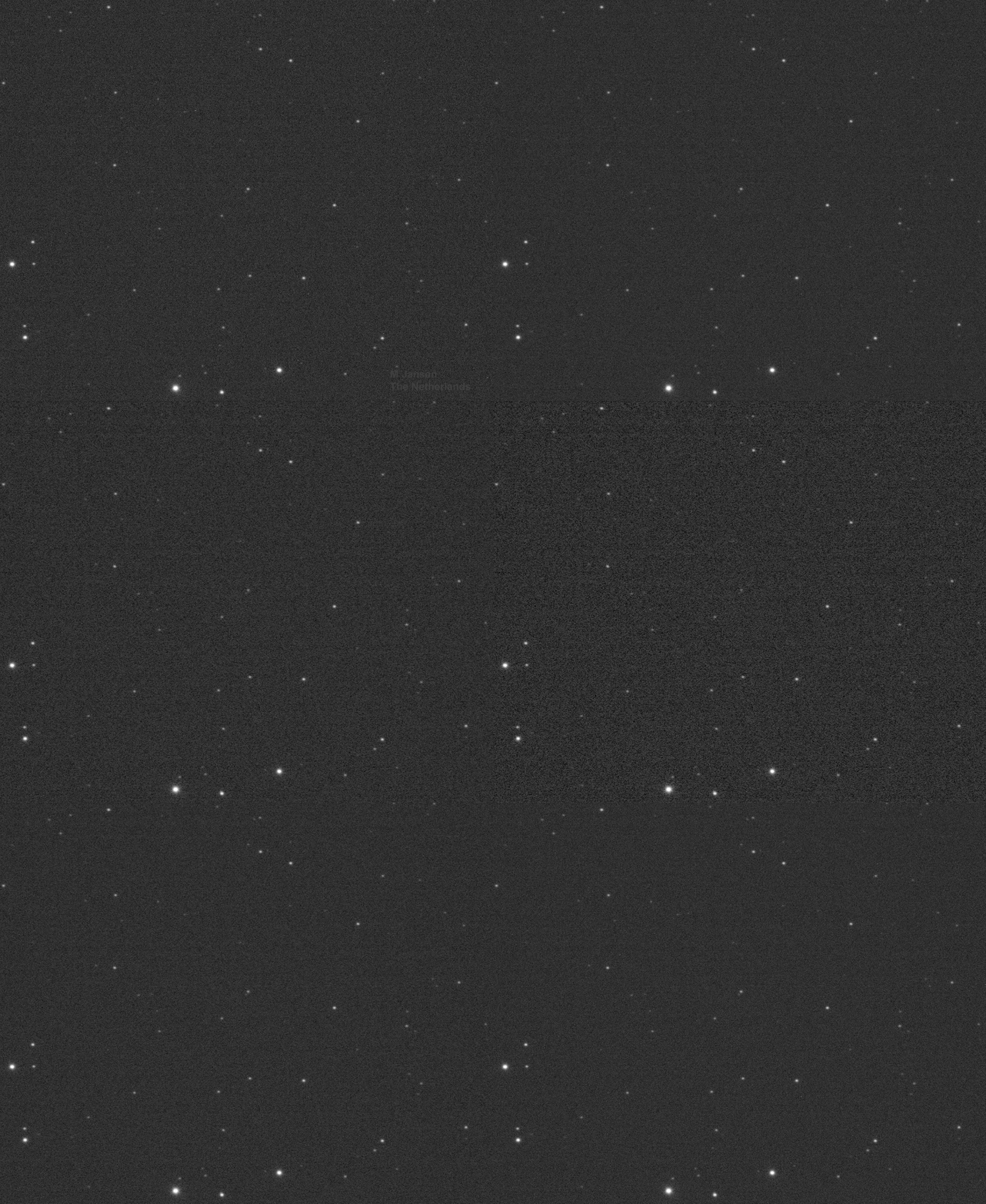
So I scrolled through my captures afterwards and I did see that the brightness indeed was changing. Of course I had to make an animation of that.
The only thing I was not sure about was if the red dwarf that was eclipsing the white dwarf or that it was the variaton of the white dwarf itself.
Huubke (a member of astroforum.nl) was kind enough to compare and check my data and it turns out it is indeed the red dwarf eclipsing the white dwarf.
It goes from MAG14 to below MAG16 and to MAG14 again and the graph also shows the same period it is happening in.
I think it's SO cool that one can capture an eclipse of a star at 1600 light years with relatively simple equipment from a balcony in a Bortle 6/7 area.
And again it shows (at least for myself) that one should never be scared off by "something is impossible". This ring for example seems impossible. But with experimenting I found that it's possible. It will take a lot of data and a lot of processing but it's possible.
Just do and try it
It's the "blinking" star in center. It's a repeating GIF and the real speed of this all is of course way slower. And no, the ring is not visible here.
With 2 hours of data and stacked and processed, it's there but very faint. But it's there

Click for a bit bigger version
Ioptron CEM25EC mount
Meade LX200 8" f/10 ACF scope
Zwo ASI071MC Pro camera
Optolong L-eNhance filter
Captures: 300sec, Gain 90, Offset 4

