
After looking up some info (I do this beforehand now
 ) it became quite an interesting object.
 NGC 3079 is about 50 million light-years away, has an apparent magnitude of 11 and is located in Ursa Major.
In the center is a supermassive black hole, which, along with active star formation, creates "bubbles" from the center. These bubbles are probably caused by very high speed particles. The current bubble is about 3,000 light-years across.
And in the context of "If you don't try, you'll never know", I started working with the Optolong L-eXtreme filter. No bubble to be seen (of course
 ) but very clearly visible are active regions with star formation.
And for me again proof that the often heard "Narrowband filters are useless for galaxies" really is much less true than people think.
More info (and photo of the bubble) at https://www.jpl.nasa.gov/images/pia0420 ... y-ngc-3079
And I also found that close to NGC 3079 is the first discovered gravitational lens. In 1979, two closely spaced quasars were discovered that looked very similar. In fact, they were practically identical with even the same spectrum.
In 1980 it was discovered that it was one quasar, Q0957+651, which is about 8.5 billion light-years away. Between the quasar and us are some galaxies about 4 billion light-years away. One of those systems is called YGKOW G1 and this is a huge galaxy located right between us and the quasar.
The system itself turns out to be heavy enough to bend light: a gravitational lens. So it bends the light from the quasar around itself.
But also time by distance: one quasar image is about 420 days ahead of another. The light therefore has to travel less distance for 1 image.
Below 3 photos.
The first is the Ha-RGB version where captures with the Optolong L-eXtreme and the Baader IR/UV Cut filter are used. Only a crop, so image is the original recording format.
The original 4000px version can be seen here: https://i.ibb.co/LpbZtfw/ngc3079-Ha-RGB.jpg
Below that the same image with annotation of various objects. The gravitational lens quasar is the "double star" to the right of the top center.
And the 3rd photo is the Ha shot.
Bortle 6/7
Meade LX200 8" f/10 ACF OTA
Ioptron CEM25EC mount (no guiding)
Baader IR/UV Cut filter
Optolong L-eXtreme filter
Zwo ASI071MC Pro camera
Captured with SharpCap Pro @ -10 Celsius / White balance R50 B50
Baader IR/UV Cut filter: 33 x 300 sec / Gain 0 / Offset 4
Optolong L-eXtreme filter: 32 x 600 sec / Gain 200 / Offset 10
Per set 20 darks and 50 (dark)flats.
Stacked with DeepSkyStacker
RGB + Ha stacked separately
Edited with Siril and Photoshop
Siril: for both stacks Background Extraction and Histogram
Photoshop: blended the red channels of RGB and Ha and that blend as a red channel in RGB. Curves, Levels, Astronomy Tools actions (Local Contrast Enhancement), Camera Raw Filter (blacks, color saturation, clarity, noise reduction)
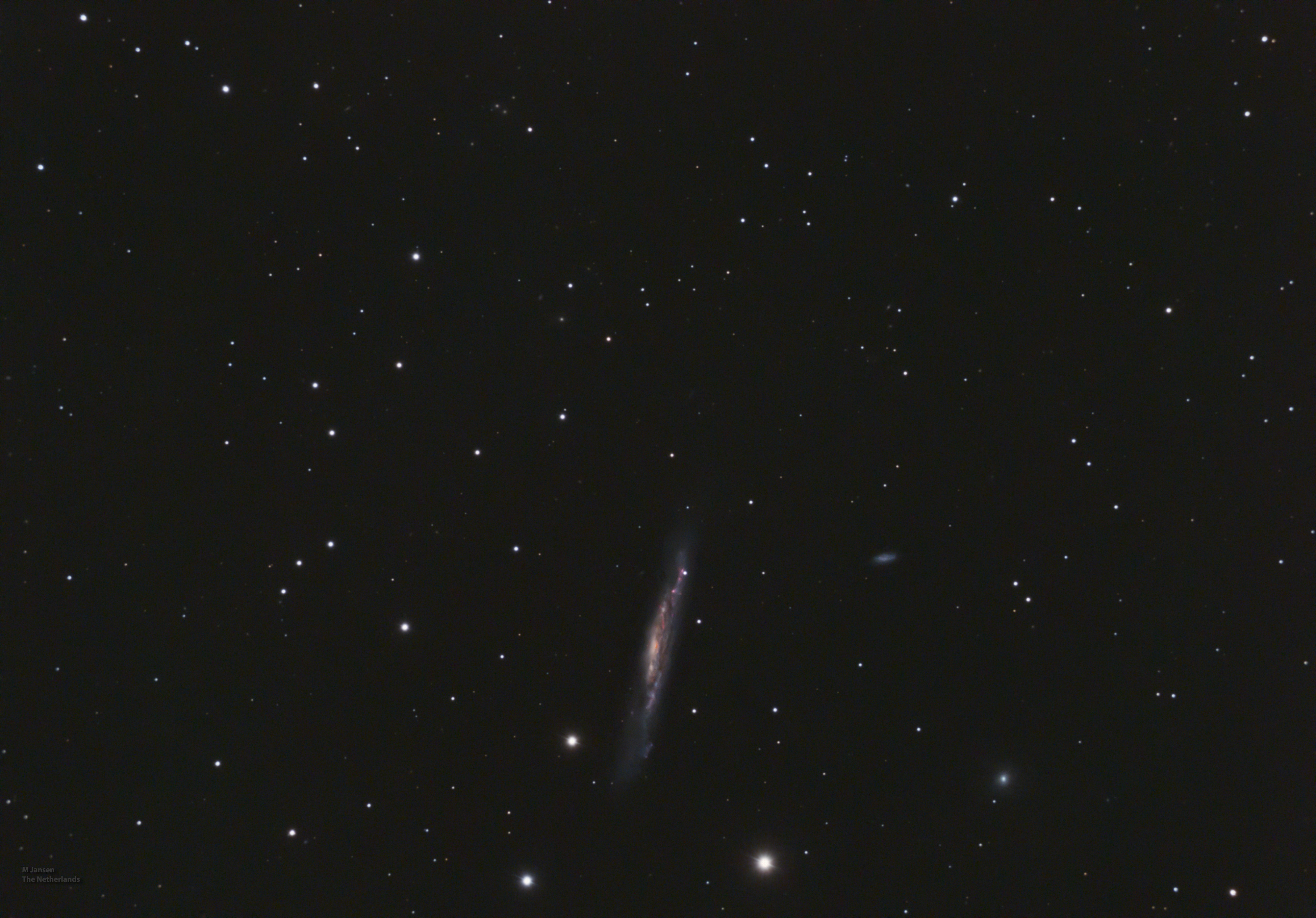
- ngc3079-HaRGB-ansm.jpg (479.33 KiB) Viewed 971 times
- NGC3079-Hasm.jpg (238.58 KiB) Viewed 971 times

